


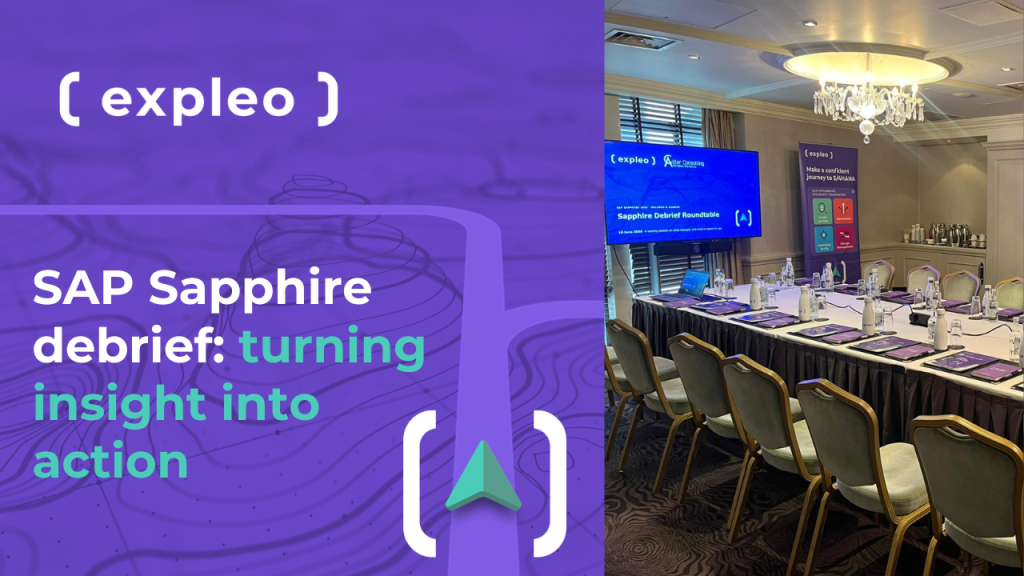
Earlier this month, Expleo brought together a group of SAP practitioners, IT and business leaders, and consulting partners to debrief on the key themes coming out of SAP Sapphire in Orlando and Madrid.
- Organised by Expleo and co-presented with our partners from Aliter Consulting.
- Expleo hosts: Melanie Byrne, Cathal Murphy, and Rory Gallagher
- 16 June 2026 – Dublin
This peer-to-peer session delivered candid views on where the autonomous enterprise vision is genuinely useful, where it is still aspirational, and what it really takes to get there.
The autonomous enterprise vision
The roundtable centred on the headline narrative from SAP Sapphire: the move toward an autonomous enterprise underpinned by AI agents embedded across the SAP estate. There was clear interest in the direction of travel, but also a healthy realism about the gap between the keynote demos and day-to-day operations.
The recurring theme was that none of this works without strong foundations. Good data, well governed master data, and robust security were repeatedly named as the real prerequisites for any meaningful AI adoption. Several attendees made the point that the AI conversation quickly becomes a data quality conversation, and that organisations underestimate how much groundwork sits beneath the promise of autonomy.
Clean core and the custom code question
The clean core principle generated some of the liveliest discussion. Attendees who are mid journey to S/4HANA and RISE spoke openly about the challenge of custom code remediation and the mindset shift required to stop bending the core system to fit bespoke processes.
The consensus was that achieving a clean core is less of a technical exercise and more of a cultural one. Moving bespoke logic and processes out to the platform layer was seen as the right pattern, but one that demands discipline and a genuine change in how teams think about customisation. There was clear appetite for better tooling to support custom code analysis and migration, and an action was taken to investigate the custom code and migration assistant tooling promised at the event and report back with clearer detail on how it actually works in practice.
Rise, licensing, and commercial clarity
The conversation turned to the commercial realities of RISE and the broader licensing picture. Questions were raised about whether a RISE contract is effectively a gateway to accessing AI capabilities, and about the practical and commercial implications of committing spend with SAP.
Experiences shared around the table covered:
- The challenges of managing upgrades under RISE
- The need for genuinely proactive support, and
- The difficulty of forecasting cost under consumption based models.
There was strong agreement that licensing and entitlement deserve dedicated expert attention, and the group agreed it would be advantageous for organisations to arrange an independent review of current licensing and consumption to produce a clearer cost and entitlement assessment.
Data strategy as the real enabler
If one thread ran through the entire day, it was data. Attendees consistently returned to the point that effective AI depends on a comprehensive data strategy spanning both SAP and non-SAP sources.
The discussion explored the difficulty of integrating external data into the SAP ecosystem, the value of a centralised and well-governed approach, and the role emerging data management capabilities could play in unifying these sources. The sentiment was that organisations cannot treat data strategy as an afterthought to AI; it is the precondition.
AI in practice
The conversation later moved from strategy to lived experience, including a firsthand account of building an application in SAP’s AI studio using natural language prompts. The demonstration captured both the promise and the rough edges of the current tooling: it could generate functional requirements and scaffold an application, but it did not build cleanly, reinforcing the earlier point that data and security cannot be skipped. There was a frank exchange on the new conversational interface and what it could mean as a front door to the wider SAP experience.
What customers are actually asking for
Rather than abstract enthusiasm, attendees shared the concrete AI requests coming from their own businesses:
- Financial reporting and real time margin visibility
- Factory scheduling and MRP
- Quality control
- Vision-based inspection systems.
A notable counterpoint emerged on adoption sentiment. In some organisations, users are less likely to be requesting AI and more likely to be anxious about it replacing them. This human dimension was treated as a real factor in any rollout, not a footnote.
Governance, monitoring, and cost control
As the conversation progressed, governance became a central concern. The group discussed the emerging idea of an agent hub for governance and compliance, including the ability to preselect large language models and set spend limits.
When discussing practical concerns, we questioned ourselves:
- How to monitor agent behaviour?
- How to keep AI credit consumption under control?
- How to avoid unexpected bills?
Application lifecycle and monitoring tooling was raised as part of the answer, alongside the integration of agents with process intelligence capabilities to keep behaviour observable and compliant.
We noted that all of this demands a new and hybrid skill set, blending technical SAP knowledge with business process understanding and AI governance.
A few real-world examples grounded the discussion, including procurement functions delivering rapid returns within months, and an alternative lower cost model based on running large language models on bulk GPU capacity. The appetite for an architecture that stays agnostic and avoids platform lock in was clear.
Treating AI as a business decision
The closing strategic theme was discipline. Attendees argued for treating AI like any other technology investment: anchored to a real business problem, justified on value, and filtered through governance rather than hype. The idea of a dedicated council to steer AI delivery resonated, as did the cultural challenge of cutting through noise to focus only on genuinely value adding use cases.
Closing sentiment
The overall mood of the day was constructively sceptical. There was real enthusiasm for the autonomous enterprise direction, tempered by a shared understanding that the hard work sits in the foundations: clean core discipline, data quality and strategy, commercial clarity on licensing, and pragmatic governance.
The most valuable outcome was the honesty of the conversation itself, with practitioners comparing notes on what is working, what is not, and what to be cautious about as the AI narrative accelerates.
Further considerations
- Commission a clean core assessment now. Use it to have the RISE or GROW conversation with facts, not assumptions.
- Review the RISE contract against new entitlements. Prioritise Business Data Cloud and master data governance.
- Protect the critical path. Run a 30 day Sapphire impact review: design for now versus activate later.
- Start a readiness assessment now. Design for the Autonomous Enterprise from the outset.
- Model the AI capability gap over five years, not just infrastructure cost. The contract is where strategy is enforced.
- Review your SAP license agreements against what SAP now sells?