

Rajesh Krishnamurthy, Group CEO – Expleo
“As Sundar Pichai, CEO of Alphabet, put it: ‘The future of AI is not about replacing humans, it’s about augmenting human capabilities.’ That captures my own view perfectly.
AI is meant to be an additive force. At its best, it enhances what we already do to become more efficient, more effective, faster. It’s not meant to replace, it makes what we do already better and the lives of people easier.
“So, to understand where AI is headed, surely we need to understand the people deploying the technology and using it day-to-day in their working lives. How excited are they about the opportunities AI brings? How worried are they about the impact on their business or job?”
If we can understand these sentiments, surely can we understand the path AI is on?
This is why we created the Expleo AI Pulse.
Introducing the Expleo AI Pulse
This, we believe, adds a new dimension to our understanding of AI today, providing organisations with greater insight to inform their own decision-making as they get to grips with the technology. To say goodbye to AI hype and hello to practical AI.
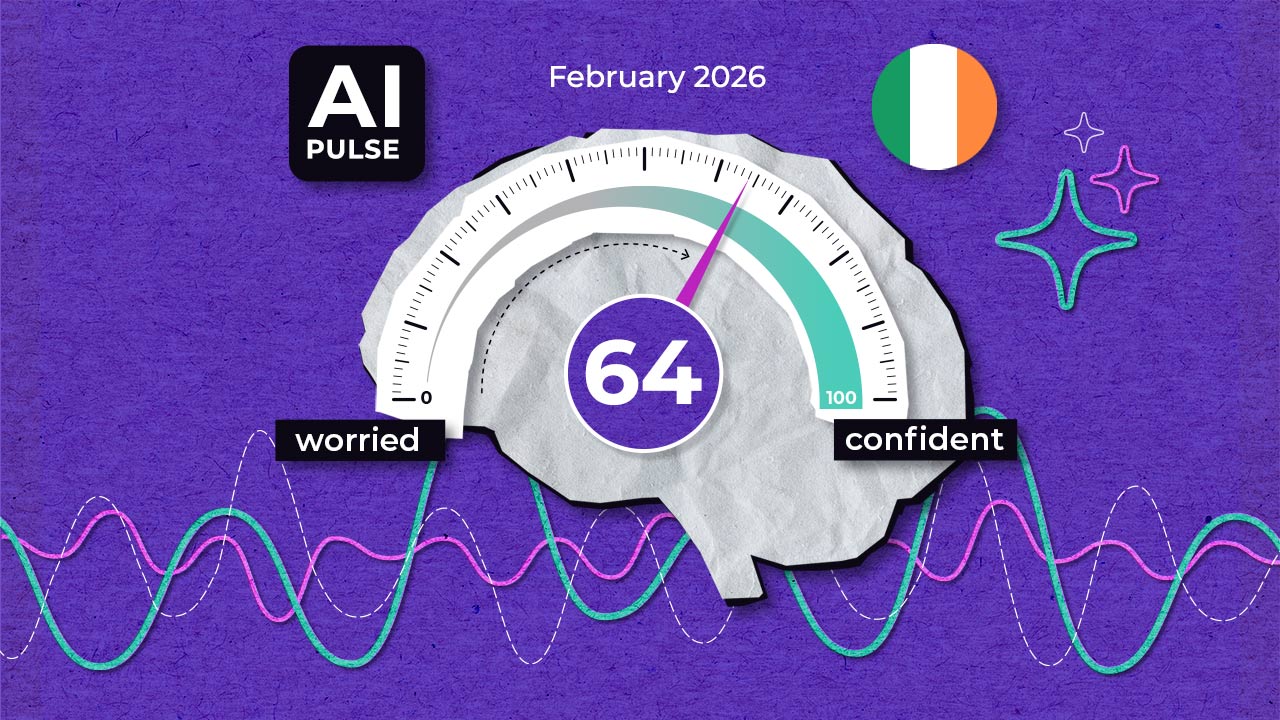
The Pulse surveys working-age adults in France, Germany and the UK, measuring levels of worry, excitement, trust and confidence about AI in business. Each month, the data is consolidated into a single score from 0 (very worried) to 100 (very confident), giving a clear snapshot of sentiment.
With the framework clear, let’s look at this month’s findings: how confident are people really feeling about AI in business?
Consistent confidence towards AI in business
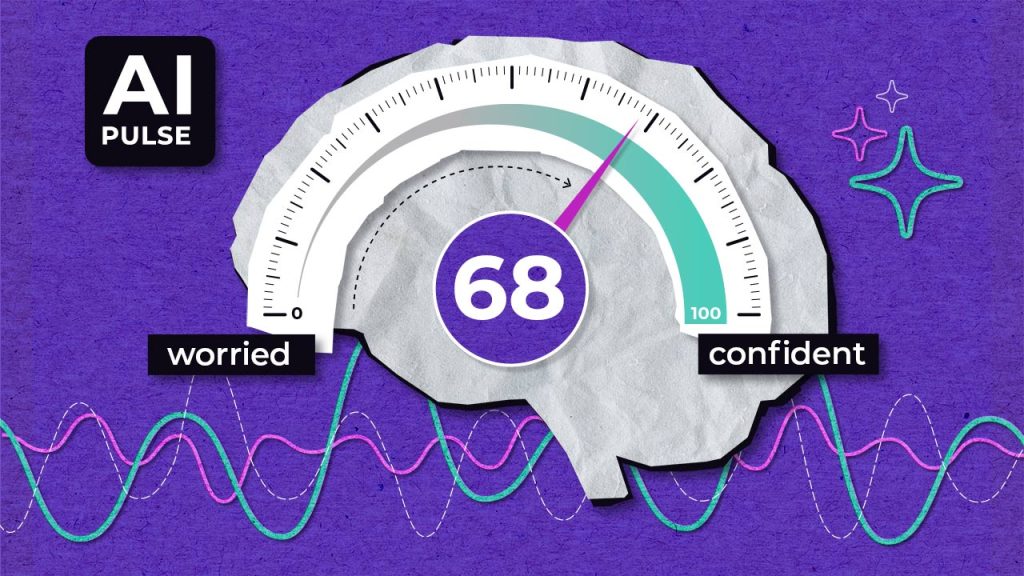
Well, people are feeling quite confident. An index score of 68 tips quite comfortably into the ‘confident’ segment.
That confidence follows the momentum we’re seeing: VC funding for generative AI worldwide in H1 2025 outstripped the total investment seen across all of 2024. But remember: this isn’t just a story of capital, it’s a story of people.
Confidence is rising because individuals are beginning to see AI not as a distant concept, but as a practical tool that’s improving their working lives. Many report that AI is helping them make faster decisions, reduce repetitive tasks, and focus more on creative or strategic work. It’s freeing up time—not replacing effort.
There’s also a growing sense of agency. Employees feel more involved in shaping how AI is used, with clearer communication from leadership and more opportunities to upskill.
And perhaps most importantly, there’s a shift in mindset. AI is being seen less as a threat and more as a collaborator.
Region | Expleo AI Pulse Index Score |
|---|---|
France Germany United Kingdom All markets | 66 67 73 68 |
Table 1: Expleo AI Pulse Index Score – August
When we look into this on a country level, we see a small divergence with the UK marginally ahead of its EU counterparts. That five-point score above the mean might not be large but it is significant: across the full survey the UK scored higher in confidence than the other markets in virtually all categories. With the UK as the third-largest AI market in the world, this stands to reason, pointing to an overall higher level of AI exposure across a wider audience.
The saying goes that ‘familiarity breeds contempt,’ but with AI the opposite is true. As people experiment with AI tools, confidence grows. I saw this myself with my first tests of ChatGPT and Midjourney – imperfect, but powerful and tangible. As more people experience their own ‘eureka moment,’ not just early adopters but everyday users, confidence will only deepen.
UK confident; France and Germany cautious on AI regulations
Over the summer, some of the biggest developments in AI focused on regulation. As the technology reaches critical mass, national governments and international bodies moved to create legislation to balance growth and innovation with the protection of users.
Perhaps most notably, the US announced its AI Action Plan, a series of policies from the world’s biggest economy’s proposals to cultivate and maintain a leadership position on the technology. Likewise, the EU AI Act and UK AI Opportunities Action Plan have been in the headlines as the EU and UK look to carve out their respective paths on AI, for local businesses and their people.
With this in mind, we asked whether people felt those regulations would support ethical use of AI in business. Here, we saw arguably the greatest divergence in our audiences. In the UK, nearly two-thirds (62%) said they believe current regulations would support ethical use of AI, while France (46%) and Germany (42%) lagged noticeably behind.
That difference is even starker when we look at the net agreement scores, with the UK coming out at a 44% net score, France down at 22% and Germany barely scoring positively at just 7%.
What does this tell us? Firstly, there are far greater concerns on the Continent. With the UK typically having a lighter touch approach to business regulation than its EU counterparts, this might be expected. Likewise, the similar responses between France and Germany suggest some misgivings towards the EU’s marquee AI regulation in the bloc.
This will surely be an area to watch in the coming months as the AI ecosystem develops and regulators look to keep pace with the market.
Fears about AI impact on jobs low – reflects overall confidence in AI
No discussion of AI in business would be complete without a look at the impact on jobs. In all discourse on AI, it remains one of the topics front of mind. Perhaps surprisingly, then, when asked how worried they were about the impact of AI on their job, all markets tended towards being unworried.
Region | Worried | Unworried | Net worried |
|---|---|---|---|
France Germany UK All markets | 38% 34% 37% 36% | 61% 65% 63% 63% | -23% -31% -26% -27% |
Table 2: Responses to “How worried are you about the impact of AI on your job?” = August 2025
“With roughly two workers not worried about the impact of AI on their job compared to one that is concerned, there clearly remains some underlying caution. However, those fears are yet to be realised or fallen some way short of the prophecies of the doomsayers”
As the early waves of AI-led technologies have bedded in, it’s fair to assume the reality of what AI is – and isn’t – has become a little clearer. It’s my belief that familiarity with the technology is an important precursor to adoption and embracing of any technology. AI is still at a relatively early stage of its journey in business, and so there might be some volatility in responses to this question over time.
As a final note, it’s interesting to see the trend of the answer to this question mirror quite closely to that of the overall Expleo AI Pulse Index Score, suggesting that career and professional prospects are a good bellwether of sentiment towards AI in business. Remember, AI is about people, and those people care about their jobs.
A Human-centric future, powered by AI
The Expleo AI Pulse shows that confidence in AI is growing because it’s becoming more than abstract promise. People are also beginning to see AI not as a replacement, but as a partner that is starting to enhance their own capabilities.
This month’s findings reflect a workforce that is increasingly empowered, optimistic, and involved. AI is being shaped by people, for people. It illustrates how deeply reliant AI adoption is on cultural shifts as much as technological advancements.
These cultural shifts will ebb and flow, and sentiment will evolve. The real story is how that shapes business strategy. We’ll be tracking this closely in the months ahead