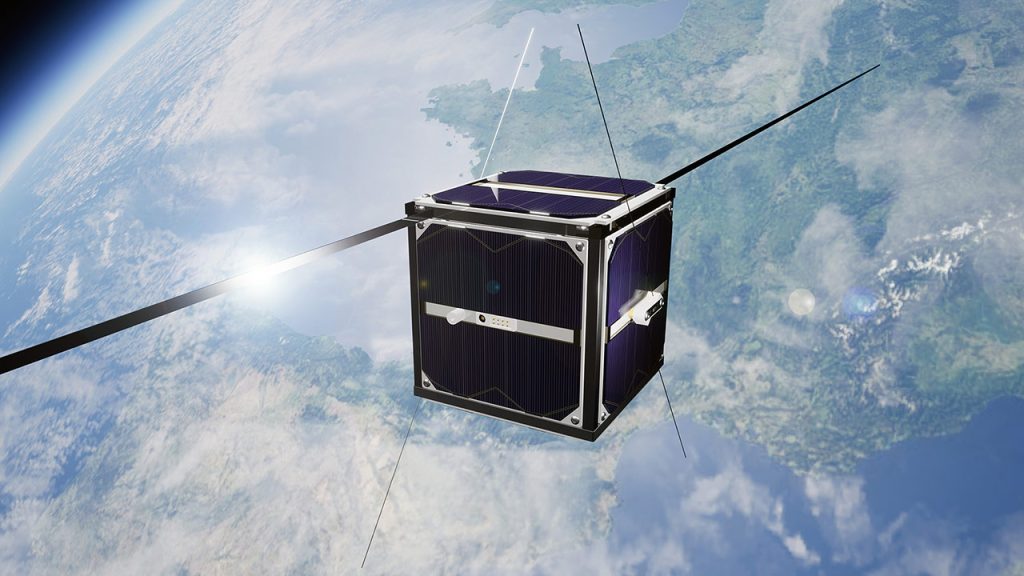



Paris, 13 November 2025 – Expleo, a global engineering, technology and consulting company, announces the end of the mission of its ENSO (Expleo Nanosatellite for Solar Irradiance Observation) nanosatellite, after almost two years in low orbit. A collaboration with the Montpellier University Space Centre (CSUM), the launch and mission of ENSO will serve as a reference for ongoing innovation in the NewSpace field.
ENSO is a 1U CubeSat nanosatellite measuring 10x10x10cm and weighing just over 1kg. Launched on 1 December 2023 into low orbit, it gradually re-entered the Earth’s atmosphere, where it re-entered the atmosphere on 9 November 2025, leaving no debris or orbital pollution, having remained operational by CSUM until its demise.
ENSO carried several systems designed and developed by Expleo engineers, including the mission controller enabling communication with the CubeSat platform provided by CSUM, and to manage two payloads, also designed by Expleo.
During its operation, the control commands were fully operational and the first payload provided hundreds of images from a 6g camera with a focal length of 3.1 millimetres. This camera, which was not initially designed for space, survived intense solar activity without any pixel malfunctions, demonstrating the success of the work accomplished.
The second payload, comprising a radio frequency signal beacon and an active antenna deployment system, was designed to enable ENSO to measure the Earth’s ionosphere. Although the payload was able to generate the radio frequency signal, the incomplete deployment of the six-metre-long antennas prevented the signal from being transmitted properly to Earh.
A springboard for learning and NewSpace innovation
ENSO remains a success for Expleo and CSUM. The experience gained will be particularly valuable for future space projects for Expleo clients. The learning process in NewSpace technologies and the space ecosystem has been a success: teams have developed their skills in embedded electronic systems, developed an AIT (assembly, integration, testing) business, and managed Expleo’s clean room.
Today, Djibouti and Senegal have benefited from Expleo’s expertise. Based on the CSUM’s 1U platform and with Expleo’s payload, their nanosatellites are fully operational to date. Two of their satellites are still fully operational today, the third one having reached end-of-life early September 2025.
The ENSO mission, initiated by Expleo in close cooperation with CSUM, has been used proactively in the education of students, with the support of the Van Allen Foundation, of which Expleo is a founding member.
“The feedback from the Expleo mission has been absolutely incredible. It is the culmination of many years of passionate work in R&D, involving multi-disciplinary teams. ENSO has enabled us to develop and hone new engineering skills and methodologies adapted to the needs of the market and to validate several technological building blocks in orbit. Seeing our team’s efforts since 2019 pay off with the launch in December 2023 was a source of pride; validating the success of operations right up to the very last moments of the satellite in orbit is another. This first NewSpace programme now enables us to offer our customers a relevant service, understanding their need to balance performance, costs and scheduling building blocks in orbit,” explains Valentin Martelet, Space Offer Leader, Expleo.
“ENSO combines Expleo’s expertise with CSUM’s knowledge and experience in platforms, nanosatellite launches, and training for space-related careers. At least 20 students, interns and apprentices enrolled in the Specialized Master’s in Space Systems Development (MS DSS) by Polytech Montpellier participated in the entire project. This is a highly successful collaboration between industrial and academic partners,” added Laurent Dusseau, PhD, Director of CSUM and the Van Allen Foundation.